Volts and Amps Decide How Many Solar Panels Fit, Not Watts
Two numbers on the spec sheet decide how many solar panels you can connect, and the watt rating is neither of them. The two that matter are the voltage window and the current limit on each input. Get those right and the watts look after themselves; read only the watts and you can buy panels that will not work, or that destroy what you plug them into.
Take the smallest unit here. The Anker SOLIX C300 Portable Power Station, 288Wh accepts 100 W of solar, so a 100 W folding panel is the obvious match, and it is the right one. But the number that decides it is the 28 V ceiling, not the 100 W. A folding panel that opens at 24 V clears it in ordinary weather and sits about half a volt under it on a hard winter morning. A rigid roof panel of any normal size opens at 40 V or more and must never go anywhere near it, whatever its wattage says.
This is for anyone matching panels to a power station or an inverter. The table uses one 450 W rigid panel, which opens at 39.7 V with a 13.89 A short-circuit current, at a design temperature of 0 °F, because that is the panel most people are deciding about. Your panel and your winter will differ, which is the whole reason the calculator exists.
The answer at a glance
| Unit | Voltage window | Amps per input | 450 W panels |
|---|---|---|---|
| Anker SOLIX C300 | 11-28 V | not published | none, use a different panel |
| Pecron F1000LFP | 11-60 V | 14 A | 1 |
| Pecron F3000LFP | 25-120 V | 25 A | 1-2 |
| Pecron F5000LFP | 30-180 V | 25 A x2 | 2-8 |
| EcoFlow Delta Pro Ultra X | 80-500 V | 15 A x2 | 3-22 |
| EG4 6000XP | 120-385 V | 17 A x2 | 5-16 |
| EG4 FlexBOSS21 | 120-440 V | 26/26/15 A | 5-33 |
Seven units, and the range runs from none to thirty-three on identical panels. Nothing about the watt ratings predicts that spread.
Volts: a ceiling that breaks things and a floor that stops them
Panels wired in series add their voltages. A panel's open-circuit voltage also rises as it gets colder, and that is the fact most first arrays are sized without. Our 450 W panel opens at 39.7 V at standard test conditions and about 43.9 V at 0 °F, roughly 11 % more. Every panel in the string does it at once, on the coldest, brightest morning of the year.
The ceiling is a hardware limit, not a warning light. Cross it and you have damaged the input. Use your location's record low rather than its average winter low, because the array only has to see that temperature once.
The floor gets less attention and stops just as many builds. A string below the minimum tracking voltage produces nothing at all, and no rewiring fixes a string that is simply too short. The EcoFlow Delta Pro Ultra X Inverter wants at least 80 V, so a single panel will not start it and two is marginal. Three is the shortest string that works.
Both limits are per input, and they are separate numbers on most sheets: one for what the unit survives, a narrower one for where it actually tracks. A string sitting between the two is not broken, it is just not earning.
Amps: the limit that decides how many strings
Series adds volts. Parallel adds amps. That is the whole toolkit, and the input's current rating is what decides how much paralleling you are allowed.
Size against the panel's short-circuit current, not its operating current. Short-circuit is the number the input has to survive, and it is the larger of the two. Our 450 W panel is 13.89 A short-circuit.
Now the arithmetic that catches people. The Pecron F1000LFP Portable Power Station, 960Wh allows 14 A. One panel fits with about a tenth of an amp to spare. Two in parallel is 27.8 A, which is double the limit, so its 600 W rating is unreachable with panels of this kind no matter how much roof you have. The EG4 FlexBOSS21 16kW AC Hybrid Inverter, at the other end, allows 31 A of short-circuit current on each of its two big inputs, and two strings come to 27.8 A. That is precisely why it exposes two connectors per input and the 6000XP exposes one.
This is the trap worth knowing before you shop: some units publish a solar rating built around the maker's own low-current folding panels. Feed them ordinary rigid panels and you break the voltage limit or the current limit long before you reach the advertised watts. In long-term reviews this has repeatedly turned a headline solar figure into something unreachable with normal hardware.
Bifacial panels have a trap of their own here, and it lands on the current side rather than the voltage side. The rear face adds current, not volts, so the panel's real short-circuit figure is higher than the number printed on the front-side line of its data sheet. How much higher depends on how bright the ground under the array is, and the sheets say so: several state up to 25 % of extra output from the back, one states 30 %. Work an example through and it changes an answer. The EG4 FlexBOSS21 16kW AC Hybrid Inverter has a third, smaller input rated 15 A. A single string of one 550 W bifacial panel sits at about 13 A on its front-side figure, which fits, and about 16 A once the rear face is counted, which does not. Its two larger inputs take that panel happily; the small one cannot have it at all. Size a bifacial array on the highest gain its sheet states and bring the number down only if the array really will sit over something dark.
Paralleling is not free either. It wants branch connectors, thicker wire for the higher current, and a fuse on each string so a fault cannot push current backwards into a panel.
Watts come last, and there are usually two watt numbers
By the time volts and amps are settled, the watt rating is mostly a sanity check. It is worth knowing that sheets often publish two, meaning different things. A "maximum utilised solar power" figure is where the unit stops converting any more, a clipping point. A "recommended maximum solar input" is the array size the maker will stand behind. The EG4 | 6000XP Off-Grid Inverter publishes 8,000 W and 10,000 W respectively, which is why you see both quoted for the same unit.
Going past the clipping figure on purpose is normal and fills the shoulders of the day. What you must not do is assume the input protects itself. Most will shut down; not all do. One power station rated for 800 W of solar has been destroyed by 1,000 W of panels rather than simply switching off, twice over, in long-term testing.
Watt limits also apply per input. The 6000XP allows 4,000 W on each of its two inputs, which caps each one at eight of our panels rather than the ten its voltage and current alone would permit.
Choose the panel before you choose the string
Every number above traces back to one panel's open-circuit voltage, its short-circuit current, and its temperature coefficient. Change the panel and every answer on this page moves. So the panel is the first decision, and those three figures are what to write down from its data sheet.
Best value per watt right now
Per-watt figures use the panel's rated STC output, a laboratory number that real output falls short of. Pallets and folding panels are ranked separately inthe calculator.
The units, smallest input to largest
Anker SOLIX C300 Portable Power Station, 288Wh
An 11-28 V window and 100 W, which is one folding panel and nothing else. A 100 W portable panel that opens at 24 V is the shape that fits, and it is worth seeing how little room there is: run that panel through the cold-voltage correction and it reaches about 27.8 V at 5 °F, then crosses the 28 V ceiling below that. If its data sheet publishes a temperature coefficient you can use the real figure and it stays inside even in deep cold; without one you are stuck with the conservative table, and the honest answer is that this pairing is fine for camping weather and marginal in a hard freeze. A rigid roof panel is not marginal, it is simply out. Owners also report the unit is slow to notice a panel has been connected, so give it a minute before deciding it is broken.
Anker SOLIX C300 Portable Power Station, 288Wh
Price as of Nov 4, 2026. Prices and availability change; check the retailer for the current figure.
Check price at Amazon →Affiliate link. We may earn a commission.Pecron F1000LFP Portable Power Station, 960Wh
A 60 V ceiling and 14 A on one front input. Exactly one standard panel, with very little margin on either limit. The cheapest way to charge from a panel you already own.
Pecron F1000LFP Portable Power Station, 960Wh
Price as of Nov 4, 2026. Prices and availability change; check the retailer for the current figure.
Check price at Amazon →Affiliate link. We may earn a commission.Pecron F3000LFP Portable Power Station, 3072Wh
A 120 V ceiling and 25 A on a single input carrying the whole rating. Two panels in series fit; three do not. A single input is unusual at this size and it is the thing to notice here.
Pecron F3000LFP Portable Power Station, 3072Wh
Price as of Nov 4, 2026. Prices and availability change; check the retailer for the current figure.
Check price at Amazon →Affiliate link. We may earn a commission.Pecron F5000LFP Portable Power Station, 5120Wh
Two inputs, 30-180 V, 25 A each. Four panels per string reaches 176 V against a 180 V limit, so three per string is the sane choice. Solar is also the only fast way to refill this one, which makes the generous input more than a spec-sheet nicety.
Pecron F5000LFP Portable Power Station, 5120Wh
Price as of Sep 30, 2026. Prices and availability change; check the retailer for the current figure.
Check price at Amazon →Affiliate link. We may earn a commission.EcoFlow Delta Pro Ultra X Inverter
An 80-500 V window across two inputs, which is array territory rather than campsite territory. Two points before buying: the external solar isolator is mandatory, and it arrives unwired, so budget for connectors, a crimper and cable, plus the time.
EcoFlow Delta Pro Ultra X Inverter
Price as of Nov 4, 2026. Prices and availability change; check the retailer for the current figure.
Check price at Amazon →Affiliate link. We may earn a commission.EG4 | 6000XP Off-Grid Inverter
A 120-385 V window with two inputs at 17 A each, 25 A short-circuit, and a 4,000 W cap per input. The window is wide enough to accept almost any standard panel, which is what makes it forgiving. In long-term reviews units of this class have run daily for over a year on a permanent array with no fault reported at the solar input.

EG4 | 6000XP Off-Grid Inverter
Price as of Nov 4, 2026. Prices and availability change; check the retailer for the current figure.
Check price at Signature Solar →Affiliate link. We may earn a commission.EG4 FlexBOSS21 16kW AC Hybrid Inverter
Three inputs, 120-440 V, rated 26 A, 26 A and 15 A. The most panels of anything here by a wide margin, and the only unit whose limits will not be what stops you. It is also more inverter than most houses can use, and priced accordingly.
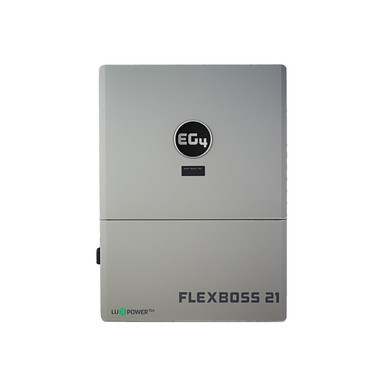
EG4 FlexBOSS21 16kW AC Hybrid Inverter
Price as of Nov 4, 2026. Prices and availability change; check the retailer for the current figure.
Check price at Signature Solar →Affiliate link. We may earn a commission.Parts list
- EG4 | 6000XP Off-Grid Inverter - forgiving voltage window, two inputs, the sensible first real array
- EG4 FlexBOSS21 16kW AC Hybrid Inverter - three inputs when one array will not fit two
- EcoFlow Delta Pro Ultra X Inverter - array-scale input without a wired install, isolator required
- Pecron F5000LFP Portable Power Station, 5120Wh - two inputs, solar as the primary way in
- Pecron F3000LFP Portable Power Station, 3072Wh - two panels in series, one input
- Panels chosen on Voc, short-circuit current and temperature coefficient
- Fuses, branch connectors and cable sized to the string current, per NEC
Who this is for, and who should skip it
This is for you if you are buying panels and the thing they plug into as a pair, or adding panels to something you already own. It is also for anyone who has been told to fill the watt allowance and suspected it could not be that simple.
Skip it if your panels came bundled with the unit and you have no plans to add more, since the maker has already done this arithmetic for you. Skip it too if a designer is sizing your system, because the strings are their job and their liability.
FAQ
How many solar panels can I connect to my power station?
Check two numbers on its spec sheet before the watt rating: the PV voltage window and the current limit on each input. Panels in series add voltage, panels in parallel add current, and the input's two limits decide the shape of the array. Many small power stations have a voltage ceiling below a single standard roof panel's cold voltage, which means the honest answer for them is none rather than one.
Why does cold weather change how many panels I can install?
A panel's open-circuit voltage rises as the temperature falls, and panels in series add their voltages together. A 450 W panel that opens at 39.7 V at standard test conditions opens at roughly 43.9 V at 0 degrees F, about 11 percent higher. Size the string against your location's record low rather than its average winter low, because the array only has to reach that voltage once to damage the input.
Should I size panels against Isc or Imp?
Short-circuit current, Isc. It is the larger of the two figures and it is the one the input has to survive. Operating current tells you what the panel delivers on a normal day; short-circuit current tells you what arrives in the worst case, and that is what the input's amp rating has to cover. Add it up across parallel strings, never across a series string, where current stays the same.
Why can I not reach my unit's rated solar watts?
Usually because the voltage or the current limit runs out first. Some units publish a solar rating built around the maker's own low-current folding panels, so with ordinary rigid panels you breach one of the two limits well before reaching the advertised watts. Check the window and the amps per input against a real panel's figures and the reachable total is often well below the headline.
Is it safe to connect more solar watts than the rating?
Going past a clipping figure such as maximum utilised solar power is normal practice and fills the shoulders of the day, but never assume the input protects itself. Most units shut down when overloaded and some do not: one power station rated for 800 W of solar has been destroyed by 1,000 W of panels rather than switching off. Exceeding the voltage or current limits is a different matter and is not safe at all.